Zone Therapy
A
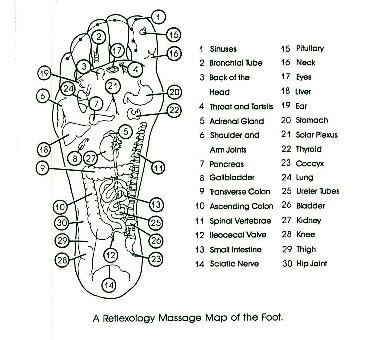
Reflexology Massage Map of the Foot
Toxin Release by Reflexology
Zone Therapy
Reflexology is a very specialized form of massage,
which, its advocates claim, is able to restore normalcy of function and
give relief from pain to virtually any part of the body. Little or no attention
has been paid to this therapy by serious investigators, but lately there
has been some interest in it, due entirely to the growing popularity of
the related therapy of acupuncture.
The two basic modes of this therapy are foot reflexology,
which is probably the best known, and hand reflexology. Together, they
are also known as zone therapy. This art has had a rather strange history,
the term zone flexology having been coined by William H. Fitzgerald, M.D.,
some 80 years ago. Shortly thereafter, it was further popularized and systematized
by Edwin F. Bowers, M.D. In the 20s and 30s, it seems to have been taken
up with some eagerness by naturopaths, although these practitioners had
so many different modes of therapy at their disposal, ranging from phytotherapy
(plants) to heliotherapy (sunshine) that they did not seem to have been
particular excited about reflexology.
The art was then taken up by a masseuse, Eunice
Ingham, who developed what she called the Ingham Reflex Method of Compression
Massage, whose principles she elucidated in a number of privately printed
book. Her students and followers set themselves up as "foot reflexologist",
and a handful of them still practice in relative obscurity.
The peculiar thing about reflexology is not that
is might work, but that there is no good reason why it should not work.
At least, anyone who has read the numerous reports on ear acupuncture would
probably feel this way.
In ear acupuncture, or auriculotherapy, there
is the assumption that on the outer surface of the ear there exist points
that are connected to many other points on and in the human body. In fact,
these points on the ear are distributed in a pattern that reflects the
shape of the human fetus in situ.
In other words, the lobe of the ear approximately represents the head.
As you move up the ear, you reach points of the body that are closer to
the feet. However peculiar this may sound, the fact is that top oriental
and Western practitioners of acupuncture have used ear acupuncture with
what they claim to gratifying success.
In reflexology, the bottom of the feet, rather
than the ears, is believed to contain points connected to all other parts
of the body.
Imaging that someone is lying on a table in front
of you, face up, with his feet together. As you look at his feet, imaging
that both of them, put together, are a "map" of the body in which the toes
represent the head area, the ball of the feet the solar plexus area, the
arch of the feet the intestines, and so on. You are now seeing things the
way a zone therapist does.
A
Reflexology Massage Map of the Foot
Let's say you have a headache. The thing to do
is vigorously massage the fleshy underpart of the big toe. Do you have
an earache? Move over to the fourth toe, drop down an inch, and rub
like the dickens. (If it's your right ear that hurts, rub your right foot.)
Backache? The inner part of the arch on both feet represents the spine,
so massage there, a few inches up from the heel. Very basically, this is
how a reflexologist goes about his business.
One definite result of the treatment is that your
feet become very sore. In fact, one method of locating the right point
to massage is to apply strong pressure to various portions of your foot
until you find a point that hurts. You are then supposed to begin rubbing
and "worked out the tenderness."
Although it may sound paradoxical to apply strong
pressure to a point on your foot that hurts, that is exactly what the usual
home treatment is for ordinary aching feet.
Toxin
Release by Reflexology
According to the reflexology practitioners, by
vigorously massage
your pressure points, your body is stimulated
and forced to release the toxins that have been built-up inside your body
into your intestinal tract. Therefore, they usually advise patients to
drink at least 2-3 cups (16-32 oz) of water during the treatment
and more after that if available. The water is supposed to flush
the toxins out of your body.
Those people who have weak liver & kidney
function are especially
in need for this type of help on getting rid
of the toxic waste out of their body.
It's not unusual to feel fatigue and sleepy after
the reflexological treatment. The results after the treatment are different
for each individual depends on type of illness, how hard and how long the
treatment is etc. For a healthy person, the treatment could help revitalize
his body and make him feel more energetic and vital. On the other hand,
a person with certain kind of illness, his pressure point connected to
that trouble organ would hurt pretty badly when being pressed. If
the treatment takes too long it would have adverse effect since the human
body can only only endure so much pain for so long. The regular treatment
should last between 7-10 minutes for each pressure point and no more than
that. Taking a short nap if time allowed after the treatment is strongly
advised by the reflexologist.
|